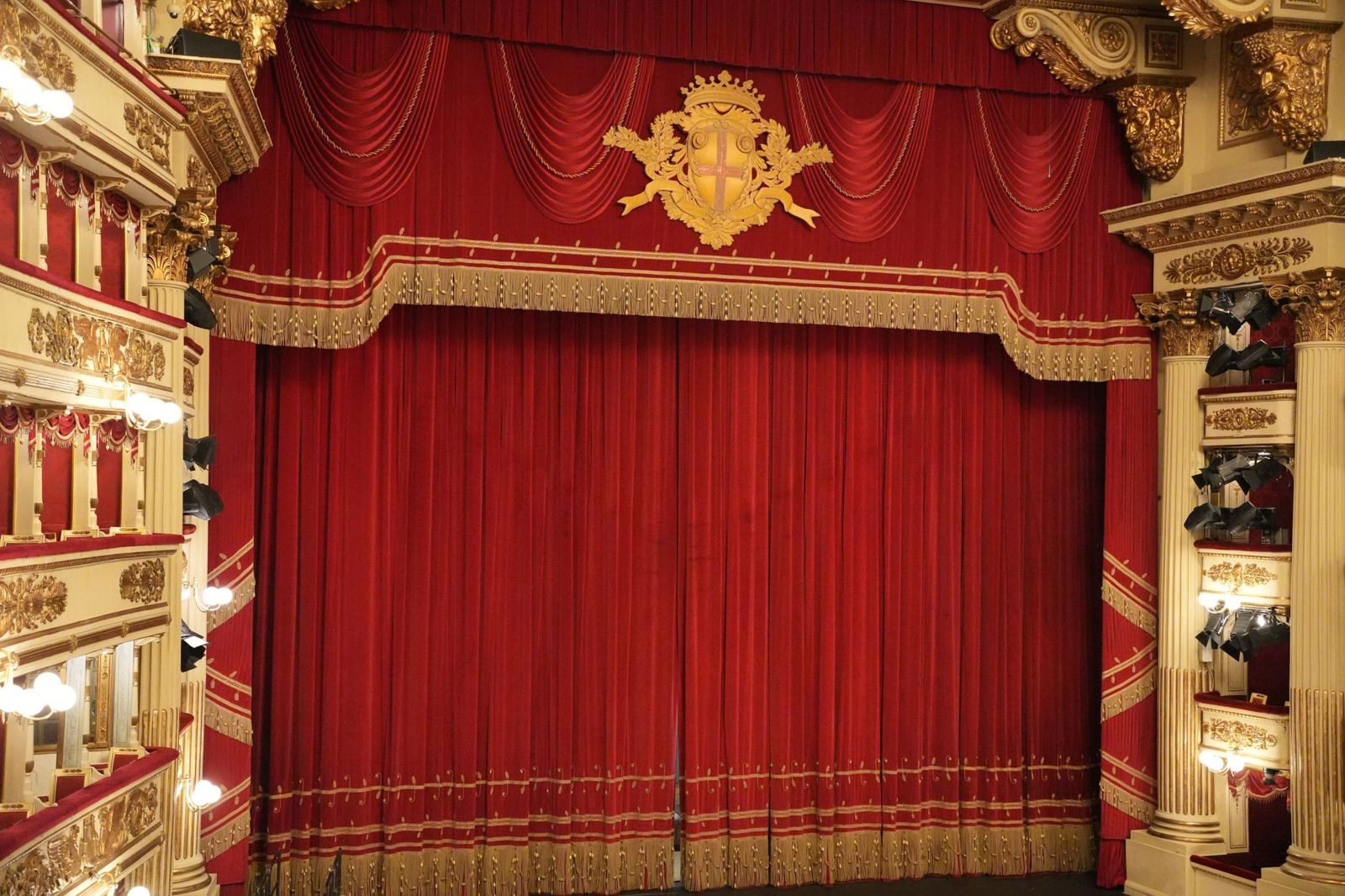
Some of the best-loved operas based on novels are Carmen, La traviata, Eugene Onegin, Manon Lescaut, Lucia di Lammermoor and La bohème, and every one of them had to throw away most of its book. A novel can spend pages inside a narrator’s head; an opera has roughly an evening and needs people singing to each other. What follows is what each composer kept, what went, and the line in each book that shows what was lost.
Premiere dates and source credits come from the Royal Ballet and Opera’s performance database, which records the source of each work. The book quotations are copied from public-domain English translations on Project Gutenberg.
Carmen: the novella that was mostly about something else
Bizet’s Carmen, an opéra comique in four acts with a libretto by Henri Meilhac and Ludovic Halévy, had its world premiere at the Opéra-Comique in Paris on 3 March 1875. Britannica dates Prosper Mérimée’s novella to 1845 and notes how badly the opera was received at first: critics were not used to seeing smugglers, deserters and factory workers given centre stage.
What nobody expects on opening the novella is the first sentence. It is not about Carmen at all. It is a scholar grumbling about Roman military geography:
I had always suspected the geographical authorities did not know what they were talking about when they located the battlefield of Munda in the county of the Bastuli-Poeni, close to the modern Monda, some two leagues north of Marbella.
Prosper Mérimée, Carmen, trans. Lady Mary Loyd, chapter I
Mérimée’s narrator is a travelling antiquarian who meets Don José by chance and hears his story only in chapter III, from José himself, who is to be garrotted. Then chapter IV abandons the plot entirely for an essay on the Roma of Spain. The opera keeps none of this frame. It gives us the story José tells, played in the present tense.
The librettists also added a character. Britannica’s cast list includes Micaëla, a peasant girl and José’s childhood friend; she does not appear in Mérimée. The bullfighter changes too. In the novella Carmen’s new lover is a picador called Lucas, who is knocked down with his horse on top of him. In the opera he becomes Escamillo, a matador, and the climax moves to the gate of the bullring.
The killing itself happens far from any crowd in the book: in a lonely gorge, after which José buries her in a wood. Her last speech, though, is already operatic:
What you ask is impossible. I don’t love you any more. You love me still, and that is why you want to kill me. … You are my rom, and you have the right to kill your romi, but Carmen will always be free.
Prosper Mérimée, Carmen, trans. Lady Mary Loyd, chapter III
Bizet did not need to invent Carmen’s defiance. He needed to move it outdoors and give it an audience.
La traviata: a novel, a play, then an opera
Verdi’s La traviata, libretto by Francesco Maria Piave, premiered at La Fenice in Venice on 6 March 1853. Strictly, the Royal Opera’s database credits it as after the play by Alexandre Dumas fils, and Britannica explains the chain: a novel of 1848, then the 1852 play, which Verdi saw in Paris having already read the book. Dumas based his heroine on Marie Duplessis, who died of tuberculosis in 1847 at 23.
The novel’s heroine, Marguerite Gautier, becomes Violetta Valéry. Her nickname comes from a habit Dumas describes with a reporter’s shrug in the anonymous English translation:
For twenty-five days of the month the camellias were white, and for five they were red; no one ever knew the reason of this change of colour, which I mention though I can not explain it
Alexandre Dumas fils, Camille (La Dame aux Camélias), chapter II
The novel opens after she is dead, with an auction of her belongings, and it includes a scene no opera house would stage: in chapter VI her lover Armand has her coffin opened, and the narrator describes her decomposed face. Verdi starts instead at a party, with her alive.
The neatest detail is a book within the book. At the auction the narrator buys a copy of Prévost’s novel, which brings us to the next opera:
A volume, beautifully bound, gilt-edged, entitled Manon Lescaut. There is something written on the first page. Ten francs.
Alexandre Dumas fils, Camille (La Dame aux Camélias), chapter III
📨 Get Free Essays And Quote Collections Alerts
Free · No spam · Unsubscribe anytime
Manon Lescaut: one novel, two operas
The Abbé Prévost’s novel produced two lasting operas. Massenet’s Manon, an opéra comique in five acts with a libretto by Henri Meilhac and Philippe Gille, premiered at the Opéra-Comique on 19 January 1884. Puccini’s Manon Lescaut, a dramma lirico in four acts, followed at the Teatro Regio in Turin on 1 February 1893.
Prévost’s novel, on Gutenberg in an anonymous English translation, is narrated by the Chevalier des Grieux, who follows Manon all the way to exile in America. She dies on an open plain where they cannot find even a tree for shelter, and he buries her in the sand, digging with his broken sword. At the moment of her death, his narration refuses to describe it:
Do not now expect me to attempt a description of my feelings, or to repeat her dying expressions.
Abbé Prévost, Manon Lescaut, part XIII
That sentence is the whole problem of adaptation. A novelist can fall silent at the climax and let the reader fill the gap. An opera cannot: the dying woman has to sing, and the composer has to write the words the narrator would not repeat.
Eugene Onegin: lyric scenes from a verse novel
Tchaikovsky did not call his Eugene Onegin an opera. The Royal Opera’s database lists it as lyric scenes in three acts, after Pushkin’s verse novel of 1833, with a libretto by Konstantin Shilovsky and the composer. It was first performed by students of the Moscow Conservatory at the Maly Theatre on 17 March 1879, and had its professional premiere at the Bolshoi on 11 January 1881.
Pushkin’s poem is driven by its narrator, who interrupts, digresses and teases, and the label lyric scenes tells you what Tchaikovsky did about that: he kept the scenes and let the voice go. What survives is the plot’s great reversal. In Henry Spalding’s 1881 translation, Tatiana, now married, gives Onegin the answer he once gave her:
I love you—to what end deceive?—
But I am now another’s bride—
For ever faithful will abide.Alexander Pushkin, Eugene Onegin, trans. Henry Spalding, canto VIII, stanza XLVI
In the poem, the next thing you hear is the clank of her husband’s spurs, and then the narrator simply leaves his hero there, Just at a moment which I grieve / Must be pronounced unfortunate
. Tchaikovsky has no narrator to make the joke, so his ending can only be the heartbreak.
Lucia di Lammermoor: Scott’s one sentence of madness
Donizetti’s Lucia di Lammermoor, a dramma tragico in three acts with a libretto by Salvadore Cammarano, after Walter Scott’s The Bride of Lammermoor, premiered at the Teatro San Carlo in Naples on 26 September 1835.
Scott’s novel is full of things an opera could never hold, such as the loyal old servant Caleb Balderstone and a family prophecy he recites in chapter XVIII:
When the last Laird of Ravenswood to Ravenswood shall ride,
And woo a dead maiden to be his bride,
He shall stable his steed in the Kelpie’s flow,
And his name shall be lost for evermoe!Walter Scott, The Bride of Lammermoor, chapter XVIII
It comes true literally: the Master of Ravenswood rides onto the quicksand and is never seen to pass it.
But the strangest thing in the novel is how little it gives the bride. On the wedding night her bridegroom is found stabbed on the threshold, still breathing, and Lucy is discovered crouched in the chimney corner, her nightclothes dabbled with blood. Scott reports her madness from outside. The only articulate words she has yet spoken, he says, are these: So, you have ta’en up your bonny bridegroom?
An opera cannot leave its heroine nearly mute, and that silence is precisely the gap Donizetti and Cammarano had to fill.
La bohème: from sketches to a love story
Puccini’s La bohème, libretto by Giuseppe Giacosa and Luigi Illica, premiered at the Teatro Regio in Turin on 1 February 1896, three years to the day after his Manon Lescaut opened in the same house. Britannica describes its source, Henri Murger’s Scènes de la vie de bohème (1847-49), as an episodic novel, and notes the young Arturo Toscanini conducted the premiere. Murger’s loose sketches became one tight love story, built around Mimì and Rodolfo.
Operas based on novels at a glance
| Opera | Composer | World premiere | Source book | What the book has that the opera drops |
|---|---|---|---|---|
| Lucia di Lammermoor | Donizetti | 26 Sept 1835, Naples | Scott, The Bride of Lammermoor | Caleb Balderstone; a nearly silent bride |
| La traviata | Verdi | 6 Mar 1853, Venice | Dumas fils, La Dame aux camélias (via his play) | The auction and the exhumation |
| Carmen | Bizet | 3 Mar 1875, Paris | Mérimée, Carmen | The antiquarian narrator; the essay on the Roma |
| Eugene Onegin | Tchaikovsky | 17 Mar 1879 (students); 11 Jan 1881, Bolshoi | Pushkin, Eugene Onegin | The talkative narrator |
| Manon | Massenet | 19 Jan 1884, Paris | Prévost, Manon Lescaut | Des Grieux’s first-person telling |
| Manon Lescaut | Puccini | 1 Feb 1893, Turin | Prévost, Manon Lescaut | The narrator’s refusal to describe her death |
| La bohème | Puccini | 1 Feb 1896, Turin | Murger, Scènes de la vie de bohème | The loose, episodic structure |
For novels about music rather than novels turned into it, see books about music. Pop has its own adaptations, from Kate Bush’s “Wuthering Heights” to the records in albums inspired by books. For what screen adaptation does to a novel, compare Pride and Prejudice, book vs film.
Carmen’s final words in the Loyd translation are not about freedom at all. Asked one last time whether she will stay with him, she answers No! no! no!
, stamps her foot, and throws the ring he gave her into the brushwood. After he has buried her, José searches a long time for that ring, finds it, and puts it in the grave beside her.
Sources
- Royal Ballet and Opera Collections, performance database: Carmen; La traviata; Manon; Manon Lescaut; Eugene Onegin; Lucia di Lammermoor; La bohème
- Britannica, Carmen (Betsy Schwarm): britannica.com
- Britannica, La traviata (Betsy Schwarm): britannica.com
- Britannica, La Bohème: britannica.com
- Prosper Mérimée, Carmen, trans. Lady Mary Loyd, Project Gutenberg #2465: gutenberg.org/ebooks/2465
- Alexandre Dumas fils, Camille (La Dame aux Camélias), Project Gutenberg #1608: gutenberg.org/ebooks/1608
- Abbé Prévost, Manon Lescaut, Project Gutenberg #468: gutenberg.org/ebooks/468
- Alexander Pushkin, Eugene Onegin, trans. Henry Spalding, Project Gutenberg #23997: gutenberg.org/ebooks/23997
- Walter Scott, The Bride of Lammermoor, Project Gutenberg #471: gutenberg.org/ebooks/471